
One of the main tenants of alternative energy is energy independence. This is one of the major reasons governments worldwide are setting up programs to encourage growth in the solar, wind, geothermal, and tidal among others, but it can be just as helpful without a geopolitical advantage in the home. People who fight through the initial investment of installing solar panels in their homes enjoy lower energy bills, or, with a larger installation, can sell their energy back to the grid to actually get a modest (albeit very modest) check from the power company every month. This also has the added benefit of encouraging energy conservation by closely connecting people to their energy use. Pavlov DID proved that positive reinforcement is better than negative after all!
The average American household in 2010 used 958kW of electricity per month[1]. This means to get 100% of your energy use covered, the panels needs to be providing 31.5kW per day, or . One major problem with solar is its intermittent nature, but by calculating averages throughout the year and being able to store energy temporarily in a battery or sell it to the grid this issue can be overcome. One additional thing to keep in mind is that these systems lose about 20% of the theoretical energy in transfer[2]. This loss will be incorporate into my calculations.
 |
| Add caption |
Things you need to know
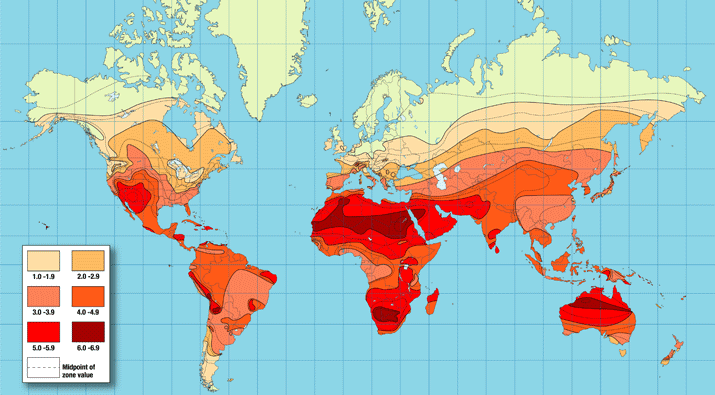
-Your area's kWh/m2/day value (equivalent to average hours of sun per day)
-Local net metering policy
-your monthly electricity consumption
-Cost of solar panels
-Cost of installation
Net Metering Explained
Although it can be quite complicated when you get up into much larger capacities, for residential installations it is actually quite simple with little variation between states. In general, local power companies are required by law to install a meter that measures your power used and power generated (thus "net" electric power metering). The value of the power generated by your renewable energy system (solar, wind, etc) will then be calculated based on retail rates and taken out of your next month's electric bill.
When you are creating more power than you are using, some states will calculate the additional value at the "avoided cost" rate. Although theoretically they should be nearly the same as retail prices[3], the avoided costs are generally much lower than retail prices[4][5], sometimes by as much as 50%, this can be a big problem for reclaiming your investment in residential solar and wind. This also encourages people to only produce as much as they use, because any incentive to go past that is severely reduced. This situation is different state-by-state, for example New York and Arizona calculate excess produced electricity with the avoided cost rates, whereas North Carolina and Washington use the higher retail prices to compensate energy produced that exceeds your household consumption.[6]
For detailed information on individual state net metering policies, look here.
Useful Vocabulary
Retail Rates: The price that YOU pay for electricity. This includes the actual fuel and maintenance costs for the power plant as well as taxes.
Avoided Cost: The cost that the power plant avoided because you created additional energy. This includes fuel and maintenance costs that were avoided as well as avoided capacity costs. Avoided capacity is the value to the power company of not creating more power plants to meet increasing demand for power. In the simplest terms possible, if the demand for power increases by 1000 kw, but people on the grid are producing 1000 kw of additional renewable energy to offset this, the power company doesn't have to spend money building a 1000 kw power plant.[7]
efficiency:
Cost of 6kw system: 7,000USD, inverter: 3000, racking+wiring: 1000, installation: $18,000
Cost of 7kw system: 9100USD, inverter: 3367, racking+wiring: 1000, installation: $21,000
cost of 7.5kw system:
Cost of 8kw system:
cost of 11kw system:
incentives: 30% paid by government - http://dsireusa.org/incentives/incentive.cfm?Incentive_Code=US37F&re=1&ee=0
each state:
Arizona -
New York -
North Carolina -
washington - $.15/kwh through 2020
too high??? installation: $2-3 / watt - http://solarpowerauthority.com/how-much-does-it-cost-to-install-solar-on-an-average-us-house/
cost of electricity in AZ: $0.1097/kwh
price for selling electricity in AZ:
cost of electricity in NC: $0.1012/kwh
price for selling electricity in NC:
cost of electricity in NY: $0.1874/kwh
price for selling electricity in NY:
cost of electricity in WA: $0.0804/kwh
many people want to jump down to lower price range
at about 7.5kw would also get 2 breakers
most people buy 5-6kw
price for selling electricity in WA:
AC breaker box (national code) is limited to 7.5kw normally
many people want to jump down to lower price range
at about 7.5kw would also get 2 breakers
most people buy 5-6kw
1.40/w
electric price per region
think-energy.net
11.54 cents/kwh nationally 2010: http://205.254.135.7/electricity/annual/pdf/tablees1.pdf
High- and Medium- Sunlight Areas
I've chosen two locations that represent the high and medium end of the solar radiation spectrum. Both Arizona and Charlotte have average electricity costs for the US, so are good examples of what to expect. To get a basis for comparison in your own state, refer to the map. All numbers in this article are calculated based on aggregate residential electricity prices in 2010 found here, adjusted for each state's relative average cost found here.
 |
| For prices divided by residential, commercial, industrial, and transportation sectors through 2010, look at the EIA's State Electricity Profile |
Solar in Tucson, AZ
At 6.5 kWh/m2/day, Tucson is one of the best places to harvest solar energy in the US. To produce the 31.5kW per day that the average household needs, you only need a 6 kW system to be 100% solar.
Installing a 7kw system
4.8
Solar in Charlotte, NC
At 5 kWh/m2/day, Charlotte finds itself right in the middle of the range for solar exposure in the US. To supply the average household with enough electricity to be completely clean and solar, you would need a 8 kW solar system.
Installing a 7kw system
6.3
Low-Sunlight Areas
In areas of the country where there is significantly less sunlight on average, it is much harder to justify the cost of a solar system. Here are two such low-sunlight cities that have very different energy costs. Electricity costs in Maine is among the highest in the country at XXXX, whereas electricity in Washington State are among the lowest in the country at XXXXX.
Solar in Buffalo, NY
At 4.1
Installing a 7kw system
buffalo: 4.1
Seattle: 3.7
Solar in Seattle, WA
At 3.7 kWh/m2/day, Olympia is one of the worst places to get solar energy (or a tan for that matter) in the continental US. In this less-than-ideal environment, your system would have to be 11 kW to sustain the average household.
Installing a 7kw system
8.75
need: cost of electricity in each region
recommended size of panel (240?)
Increasing energy costs improve payback period
Many groups worldwide, spanning from oil insiders and advocacy groups, are predicting huge increases in energy demand and price, such as the Exxon Mobile, the Edison Electric Institute, and the International Energy Institute. These increases will come steadily as population increases in the developed world, and much faster in developing countries that have to deal with faster population growth as well as adoption of modern technology and more consumption-based lifestyles. Another trend to consider is the decreasing prices of solar panels and installation costs, which came down considerably in just the past two years.[8]
An investment in solar now may be PRICEY/PROHIBITIVE/EXORBITANT, but in the XXX years it takes to pay off the investment it seems likely that we may see oil and electricity prices shoot up. These predictions and common sense show that an investment in solar is one way to ensure price stability for yourself in a market of quickly increasing demand and a supply that will not be able to keep up.
http://maps.nrel.gov/imby
http://www.altestore.com/
[1]http://205.254.135.7/tools/faqs/faq.cfm?id=97&t=3
[2]http://www.countrysidemag.com/issues/91/91-3/Rex_A_Ewing.html
[3]http://efc.umd.edu/pdf/Canney_AvoidedCostMethodology.pdf
[3]http://efc.umd.edu/pdf/Canney_AvoidedCostMethodology.pdf
[4]http://robertrapier.wordpress.com/category/avoided-cost/
[5]http://ratecrimes.blogspot.com/2009/05/avoided-cost.html
[6]http://www.dsireusa.org/incentives/index.cfm?EE=1&RE=1&SPV=0&ST=0&searchtype=Net&sh=1
[5]http://ratecrimes.blogspot.com/2009/05/avoided-cost.html
[6]http://www.dsireusa.org/incentives/index.cfm?EE=1&RE=1&SPV=0&ST=0&searchtype=Net&sh=1
[7]http://energync.org/assets/files/AvoidedCosts.pdf
[8]http://newscenter.lbl.gov/news-releases/2011/09/15/tracking-the-sun-iv/
[9]Cost information received from http://www.altestore.com/ and phone conversations with sales representatives
[8]http://newscenter.lbl.gov/news-releases/2011/09/15/tracking-the-sun-iv/
[9]Cost information received from http://www.altestore.com/ and phone conversations with sales representatives

No comments:
Post a Comment